Every evaluation begins with an observation.
An experienced evaluator walks through an orchard, examines a fruit, and makes hundreds of small judgements throughout the day. Is the background colour changing? How advanced is maturity? Is the starch pattern closer to one score than another? Years of experience allow these observations to become remarkably consistent, but they remain, to some degree, human judgements.
For organisations responsible for evaluating new cultivars, this presents a familiar challenge.
The purpose of variety evaluation is to generate reliable evidence that can support decisions worth millions of rand and many years of investment. Breeders, nurseries and growers depend on data that remains comparable across sites, seasons and evaluators. Achieving that level of consistency becomes increasingly difficult as evaluation programmes grow larger.
This is one of the reasons Provar exists.

For more than a decade, our team has worked alongside breeders, researchers and commercial growers to evaluate fruit cultivars under real production conditions. Throughout that time, one principle has remained constant: the value of any recommendation depends entirely on the quality of the data behind it.
Collecting large datasets is challenging enough. Preserving their integrity is even more difficult.
Environmental variation, changing conditions and the unavoidable subjectivity of human observation all introduce variability. While experienced evaluators are exceptionally skilled, there is always value in replacing subjective estimation with objective, repeatable measurement wherever it is scientifically appropriate.
That philosophy has guided Culteva™ from the beginning, shaping its development as a response to the challenges Provar encountered in managing large, complex cultivar-evaluation datasets.
Designing Culteva™ around real evaluation challenges
Rather than asking evaluators to work harder, we have always aimed to help them work more consistently. Good software should reduce administrative effort, simplify workflows and remove unnecessary cognitive load so that evaluators can focus their attention where it matters most: interpreting biological variation rather than managing data.
The latest release of Culteva™ represents an important step in that journey.
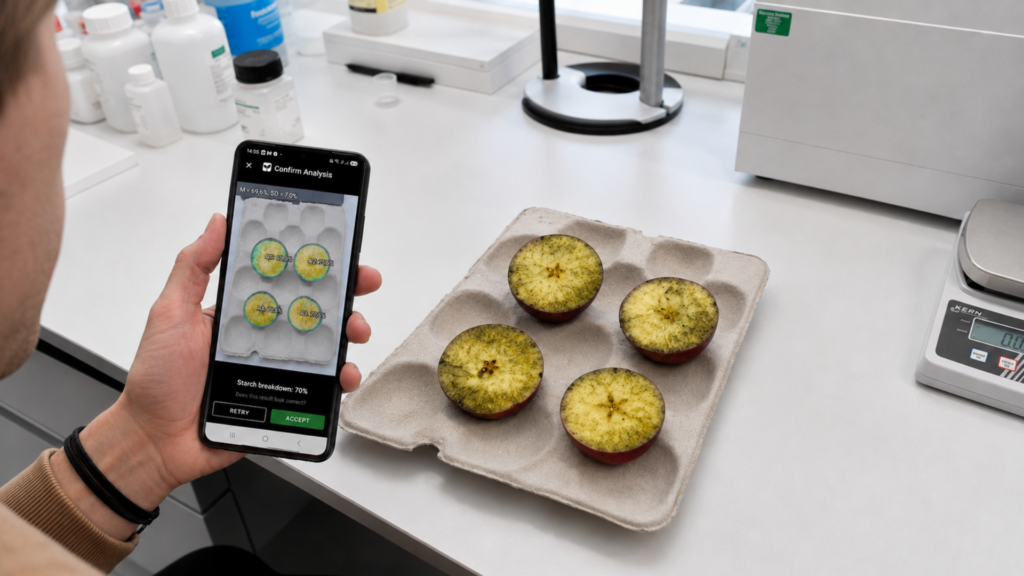
For the first time, Culteva™ combines machine learning and image analysis to assist with starch-breakdown assessment in apples using the starch-iodine test.
Anyone involved in apple maturity assessments understands the importance of starch testing. After an apple is cut and treated with iodine, the remaining starch stains dark while areas where starch has already been converted to sugars remain unstained. The resulting pattern provides valuable information about fruit maturity and harvest timing.
Traditionally, evaluating these patterns has relied on visual comparison against reference charts. Although this method has served the industry well for many years, it inevitably depends on human interpretation. Different evaluators may estimate slightly different percentages or assign slightly different scores, particularly when staining patterns are less distinct.
The new image-based starch-assessment feature approaches the same problem differently.

From visual estimation to objective measurement
The machine-learning model identifies and separates the visible areas of stained and unstained apple tissue in the submitted image. Image analysis then measures these classified areas and calculates the proportion of the visible fruit surface that remains stained. When an image contains multiple apple samples, the platform also reports the mean and standard deviation across the sample.
These measurements provide a more objective assessment that complements, rather than replaces, the evaluator’s expertise and judgement. That distinction is important.
Image analysis technology is often discussed as though it exists to replace human decision-making. In scientific evaluation, the opposite is usually true.
The role of technology is not to remove the evaluator from the process but to strengthen the quality of the information available to them. Experience remains essential for interpreting results within the broader biological and production context. What image analysis can do exceptionally well is perform repetitive visual measurements consistently, rapidly and without fatigue.
This makes the technology particularly valuable in programmes where thousands of observations are collected across multiple sites and seasons.
Why measurement consistency becomes increasingly important as datasets grow.
Small differences in measurement may appear insignificant in isolation, but across years of evaluation they can influence statistical analyses, comparisons between cultivars and confidence in research findings. Every improvement in measurement consistency contributes to stronger datasets and ultimately to better decision-making.
For our own evaluators at Provar, this release is especially meaningful because it addresses a challenge we experience directly.
Every enhancement developed for Culteva™ is informed by practical experience in commercial evaluation programmes. Our researchers understand the realities of fieldwork: variable weather, long days during harvest, large sample numbers and the constant need to balance accuracy with efficiency.
When technology genuinely reduces workload while simultaneously improving data quality, it becomes far more than a software feature. It becomes another tool that helps evaluators perform their work with greater confidence.

The introduction of image analysis into Culteva™ also represents something larger.
Artificial intelligence is increasingly being explored in agriculture, but its greatest value will not come from applying it indiscriminately. Its value will come from solving genuine scientific problems where objective measurement improves the quality of evidence.
That has always been our approach.
Rather than introducing technology because it is fashionable, we believe innovation should serve the scientific process. Every new capability should make evaluation more objective, more repeatable or more efficient without compromising scientific rigour.
The image-based starch-assessment feature is only one example of that philosophy.
Alongside this release, Culteva™ now includes some image categorisation capabilities that provide the foundation for future image-based analysis and machine learning across additional crops and characteristics. As this functionality matures, it has the potential to support objective measurement across additional aspects of cultivar evaluation that have historically relied on visual assessment.
This is not the end of a project but the beginning of a new direction.
The future of cultivar evaluation will continue to rely on experienced researchers, careful experimental design and sound scientific judgement. Those fundamentals will never change.
What will change is the set of tools available to support that work.
Image analysis and machine learning will not replace the evaluator standing in the orchard. It will simply give them another instrument with which to measure, compare and understand the biological systems they study.
For an organisation built on independent evaluation, objective evidence and practical science, that represents an exciting step forward. For everyone committed to making better decisions through better data, it offers a glimpse of where cultivar evaluation is heading next.

Gina Kuschke is the Sales and Marketing Manager at Provar, where she collaborates closely with the team responsible for the development and market positioning of the Culteva™ platform. Her work involves shaping communication, ensuring clarity and credibility. She is valued by the team for her creative approach to improving internal processes and helping optimise collaboration and efficiency across projects.